Friday, June 12, 2015

Dental appliances
Are you are experiencing jaw pain?  Do you experience discomfort or hear noises when opening your mouth?  Do you have problems sleeping or have been told you snore?  Do you have unwanted tooth wear?  Have you been diagnosed with periodontal disease?  If so, you may benefit from a dental appliance.  You may ask, what is a dental appliance or how would I know if an appliance would be beneficial? If so what one would be best for me?  This article will address dental appliances that are available in our office for sleep apnea, excessive tooth wear from clenching or grinding and habit inhibiting appliances.
Appliances for sleep apnea
A removable appliance for sleep apnea is used to bring the lower jaw forward so that the tongue is repositioned in a forward motion to open up the throat thus opening the individual’s airway.  There are many designs that can be made to fit the individual needs of each person suffering from sleep apnea.  
Silent Nite
The silent night is an upper and lower removable appliance.   This design gently repositions the lower jaw frontward as a result drawing the tongue away from the natural airway making it easier to breath.  The adjustments to jaw positioning are made using a plastic connection that comes in a variety of sizes that makes the Silent Nite unique to each individual.    An upper and lower impression is taken as well as an impression of the individual’s bite.  These models are sent in to a lab, called glidewell, where the appliance is made.  It takes about 7 to 10 days for the lab to complete the appliance and get it back to us.  Adjustments and fittings are made by your doctor on the day of delivery.[1]

[1] http://www.glidewelldental.com/snoring-sleep-apnea/product-ema.aspx
   
Silent Nite Slim Line

Thornton Adjustable Positioner (TAP)
Another great appliance for sleep apnea is the Thornton adjustable positioned (TAP).  Along with the Silent Night the Thornton appliance repositions the tongue to open the airway so that it is easier to breath.
The TAP 3 Elite appliance from glidewell, “features a simple hook mechanism attached to the upper tray that slides under a bar attached to the lower tray and positions the lower jaw forward. Three hook sizes offer increased range of adjustment. An adjustment key enables the patient to adjust the protrusion of the lower jaw while wearing the device until a comfortable and effective position is achieved.”  More information about the TAP 3 appliance can be found at, http://www.glidewelldental.com/dentist/services/removables-tap.aspx.
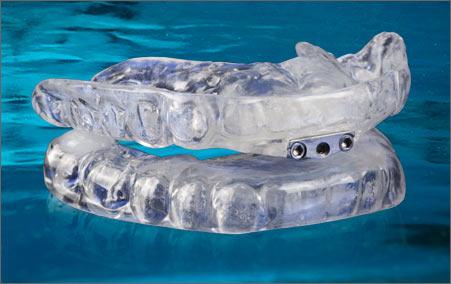
TAP 3 Elite for Treatment of Snoring and Obstructive Sleep Apnea
Thornton Adjustable Positioner (TAP)
 

Appliance for Clenching and Grinding

Wearing of the teeth, headaches in the morning, sore jaws or a constant ear pain that is not associated with an ear infection are all signs of clenching and grinding.  An easy treatment for clenching and grinding is a simple bite splint that keeps your teeth apart while you are asleep. This appliance is made to fit on the upper teeth so that when clenching or grinding occurs the splint protects the teeth from wear, protects the jaw joint from added strain, and alleviates muscle tension.[2]

[2] http://www.glidewelldental.com/dentist/services/removables-bite-splints.aspx
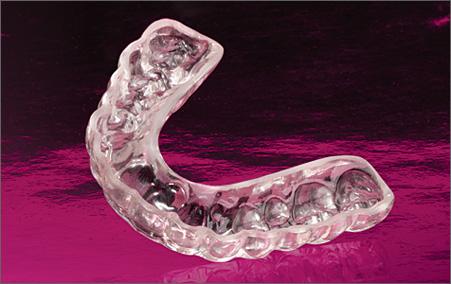

Comfort H/S Bite Splint
Night Guard


Habit Appliance
Is your child sucking their finger or thumb?  Are you having a difficult time weaning your child from a pacifier?  These helpful hints from web med will assist in being successful at helping your child quit before irreversible damage to their teeth and the supporting bone can occur.
  1. Do try to limit the time that your child sucks his thumb to his bedroom or in the house, not in public.  Berman says Explain to him/her that hi it is a bed activity during nap and at night time.
  2. DON'T turn it into a confrontation. "Don't tell your child, ‘You cannot suck your thumb anymore,'" Anderson says. "Try to recognize him and praise him when he's not sucking his thumb instead of criticizing when he is."
  3. DO talk to your child about her thumb sucking or finger sucking. "Help your child understand that when she is ready to stop, you will be there to help," Berman says. "She will eventually come to you and tell you, ‘Mommy, I don't want to suck my thumb anymore,' because you've empowered her to get there."
  4. DON'T prohibit your child if he tries to suck his thumb or fingers after being hurt or injured. "He needs to be in his comfort zone, and by not letting him go there, you're only traumatizing him more," Berman says.
  5. DO practice self-awareness with your child. "When your child is sucking his thumb, ask him, ‘Do you know you are sucking your thumb now?'" Hayes says. "If he says no, help him recognize that, and find another way to soothe him if he needs it, like a blanket or stuffed animal."
  6. DON'T use the nasty-tasting stuff that is marketed to stop thumb sucking and finger sucking. "It's just cruel," Berman says. "It's pulling the rug out from under your child and that's not fair."
  7. DO come up with creative ways to help your child understand that he is growing up and one day won't suck his thumb anymore. "Ask your child, ‘Do you think Bob the Builder sucks his thumb?'" Hayes says. "Then they'll think about, and start to process whether they want to be sucking their thumbs anymore."
  8. DON'T try a glove or a mitten on the hand as a quick-fix to thumb or finger sucking. "This will just frustrate them and cause more anxiety," Anderson says. "Likely, they're old enough to just take it off, and as a result, they'll just want to suck more."
  9. DO remember that a child will grow out of the need for thumb sucking or finger sucking when he's good and ready. "While parents may not like it, it's best left alone," Berman says. "Kids will eventually give it up."[3]
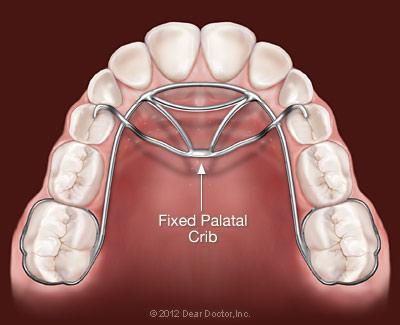
If you are worried and want to assist your child to quit harmful habits orthodontics of Utah makes a habit appliance called a “Crib”.  The Crib is a small appliance made of metal that is cemented to the child’s existing teeth preventing the sucking sensation that the child craves.  Contact your dental professional for more information.[4]


[4] ttp://www.laidlawortho.com/treatment-info/thumb-and-finger-appliances.aspx  
Fixed palatal crib.
Fixed Palatal Crib

Conclusion
Dental appliances can assist in making your life or others around you easier.  Talk to your dental professional about removable dental appliances.  I have been wearing a night-guard for many years.  I switched to a silent night about 3 months ago and have noticed an improvement in my sleeping habits.  I used the Fixed Palatal crib to help my daughter to quit sucking her thumb.  It was a successful appliance that allowed her to be in control of her choices and to feel good about the choices she was making.


Tuesday, March 31, 2015


Treating dry mouth

Does your mouth feel raw, sore or overly dry?  Do you worry about eating, fearful that you may choke?  Do you drink plenty of water but still feel like your mouth is frequently dry?  You may be suffering from chronic dry mouth.

What is chronic dry mouth? 
Dry mouth, commonly called xerostomia, comes from not having enough saliva.   Saliva assists in chewing, tasting and swallowing food.[1]  Saliva helps to protect the tissue in the mouth from bacterial, viral and other infections.  It can also protect against everyday trauma that can contribute to ulcers and other mouth sores.[2] 

Dry mouth symptoms

You may feel like your mouth is sticky making it hard to talk, swallow, taste or chew.  You may experience frequent thirst that seems to linger even after drinking.  You may have a burning sensation or you might experience mouth sores, a raw red dry tongue, or splitting at the corners of the mouth.  You may be battling bad breath which frequently accompanies dry mouth.[3]  Why should you be concerned about dry mouth?  Dry mouth can affect the health of your mouth as well as the annoying symptoms previously discussed.  It can increase the chance of acquiring gum disease such as gingivitis and periodontitis.  Dry mouth increases the risk of tooth decay (Cavities) and can lead to other mouth infections such as an oral yeast infection called thrush.   Dry mouth can also make it difficult to wear dentures.[4]

What causes dry mouth?
Dry mouth can be caused by a variety of reasons.   One of the most common causes of dry mouth is related to the body’s response or reaction to specific medications.  Several medications that can contribute to dry mouth are: “blood pressure medications, antihistamines, antidepressants, diuretics, nonsteroidal anti-inflammatories, and many others”[5] 

Other causes of dry mouth include: dehydration, mouth breathing and sleep apnea, stress, anxiety and depression, diabetes, eating disorders, and other diseases such as SjÖgren’s syndrome, lupus, and rheumatoid arthritis.[6] If you think that one or more of your medications may be contributing to dry mouth, consult your prescribing physician to discuss alternative treatment or alternative medications that may be used.

How to treat dry mouth
 As stated above; if you think that one or more of your medications may be contributing to dry mouth, consult your prescribing physician to discuss alternative treatment or alternative medications that may be used.  Other treatments for dry mouth can include drinking more water, over the counter mints and gums, and over the counter products that stimulate saliva such as: Biotene, Caphosol, and Aquoral.[7]   For some medical conditions your physician may prescribe a medication that increases saliva production called, pilocarpine hydrochloride or Salagen [8] A supplemental topical fluoride may be recommended to decrease the risk of cavities.  Visit your dental care professional on a regular basis they can assist you in diminishing irritating symptoms, help keep your gingival tissue healthy and screening for unwanted dental disease.

Continue reading below...


[3] http://www.webmd.com/oral-health/guide/dental-health-dry-mouth
[4] http://www.webmd.com/oral-health/guide/dental-health-dry-mouth
[5] http://www.medicinenet.com/dry_mouth/article.htm
 
[6] http://www.medicinenet.com/dry_mouth/article.htm
 
[8] http://www.webmd.boots.com/oral-health/guide/dry-mouth


Tuesday, February 10, 2015


What is an antimicrobial rinse?

Many of us have asked these same questions.  What is an antimicrobial rinse?   When should I use an antimicrobial rinse?  What over the counter products are effective antimicrobial rinses?

Antimicrobial is defined as:  a substance capable of destroying or inhibiting the growth of disease causing microbes.[1]  An antimicrobial rinse is a liquid substance that has the ability to destroy or inhibit the growth of microbes that can cause disease in the oral cavity such as gingivitis, and periodontal disease.[2]

Most antimicrobial rinses are designed to fight oral diseases such as gingivitis and periodontal disease.  “Gingivitis is an inflammation of the gums surrounding the teeth.”[3]  “Periodontal disease means "inflammation around the tooth.   It is a serious gum infection that damages the soft tissue and bone that supports the tooth”[4]

When should an antimicrobial rinse be used?    Each person has individual needs.  It is best to ask your health care professional to give you advice as to which antimicrobial product may be best for you.   There are many antimicrobial rinses that can help cut down on the numbers of harmful microbes in your mouth.  This article will highlight three of the most popular over the counter rinses: Listerine, Crest Pro-health, and Colgate Advantage. 

Listerine
Listerine uses a unique formula of 4 essential oils: Eucalyptol, Menthol, Methyl salicyate, and Thymol.  These unique essential oils are combined with an alcohol formula to form the liquid that we see as we look at a Listerine bottle on the store shelves.   This alcohol formula allows the unique essential oils to penetrate the cell walls of the destructive microbes thus preventing the bacteria from forming a harmful substance that can grow on the tooth surface. [5]   For those of us who have sensitivity to the burning that is evident in the traditional Listerine product, Listerine has created a less intense alcohol free formula.  Look for the ZERO™ trade mark on the label.[6]

Colgate Advantage pro-shield

The active ingredient in Colgate Advantage pro-shield is Cetylpyridinium chloride or (CPC). “Cetylpyridinium chloride is a chemical that destroys or cleanses harmful bacteria from organic surfaces.”[7]  When mixed with a peppermint flavor, it has the ability to: Kill 99% of germs on contact, significantly reduce plaque, help prevent gingivitis, and freshens breath without the burn of alcohol. Colgate Advantage pro-shield has been known to protect against germs for 12-hours even after eating and drinking.[8] 

Crest Pro-health
The active ingredient in Pro-health is also Cetylpyridinium chloride or (CPC).  “Cetylpyridinium chloride is an antiseptic ammonium compound.[9]   It can be found in some of our cleaning products and over the counter mouthwashes and toothpastes.  Mixed with Water, glycerin, and other ingredients it makes the refreshing Crest Pro-Health rinse.

Crest has created a variety of antimicrobial rinses that are designed to:  fight tarter formation, kill bacteria, remineralize the teeth, prevent plaque regrowth and fight bad breath. [10]

 As a consumer it can be a daunting task to choose a mouth rinse that will kill bacteria and cater to individual needs.  Again if there are any questions as to which mouthwash is best for you, seek professional advice.


Tess Hulet RDH, MHSM


[1]  http://dictionary.reference.com/browse/antimicrobial
 
[3] http://www.emedicinehealth.com/gingivitis/article_em.htm
 
[4] http://www.medicalnewstoday.com/articles/242321.php
 
[5] http://www.listerineprofessional.com/deepestclean
 
[6] http://www.listerine.com/products/zero-mouthwash?utm_source=bing&utm_medium=cpc&utm_campaign=Branded+-+Zero&utm_term=listerine%20zero&utm_content=Zero|mkwid|hSlCwXpu|pcrid|4753277107
 
[10] http://www.crestprohealth.com/crest-products/pro-health-rinses.aspx?utm_source=bing&utm_medium=cpc&utm_term=buy%20crest%20mouthwash&utm_campaign=CPH_Search_Desktop_Brand+Purchase_Rinse|Buy_Rinse&utm_content=byMsTomG4_4778621494_b_buy%20crest%20mouthwash
 

Friday, January 16, 2015


New treatment for sensitive teeth

Many individuals experience sensitivity that can affect their quality of life.  Eating can be painful, stepping out in the cold of winter can be uncomfortable, and professional cleanings can be unbearable.  

Sensitivity occurs when the dentin of the tooth becomes exposed, usually from the gums pulling away from the tooth which is called recession.  The dentin is constructed of small holes called dentinal tubules.  Each one of these tubules provides nerve conduction from the outside world into the nerve of the tooth causing pain or sensitivity.

Sensitivity can be caused by a variety of factors.  These may include: aggressive brushing, gingival recession, clenching and grinding, and acidic or sugary foods.

 There are many ways to treat sensitivity.  Crest has introduced an innovative way to treat sensitivity using convenient flexible strips.

“Crest® Sensi-Stop™ Strips are thin, flexible sensitivity strips that contain an active ingredient used by dental professionals. The unique strip is designed to deliver targeted contact to sensitive teeth. The Crest® Sensi-Stop™ Strips are applied along the gum line to allow the active ingredient to form a lasting barrier by blocking the exposed tubules, microscopic channels in the dentin that serve as the pathways to the nerve. Crest® Sensi-Stop™ Strips prevents hot, cold, or sweet foods and beverages from stimulating the nerve and causing pain.”


The active ingredient in Crest Sensi-stop strips is dipotassium oxalate which is accessible in a gel form placed on convenient adhesive strips.  Placement of these strips on the exposed root surface allows the dipotassium oxalate to block the nerve, inside the dentinal tubules, from feeling the stimulus from the outside world. 

Application of Crest Sensi-stop strips is easy and painless.  Chest has a great video on how to apply the Crest Sensi-stop strips.  At http://www.crest.com/crestsensistop/how-sensi-stop-strips-work.aspx

How much do Crest Sensi-stop strips cost?  Pricing from P&G E-store, CVS Pharmacy, Wal-Mart and drugstore-1 for 6 strips ranged from $17.96-$21.99.  Amazon came in with $26.99 for 12 strips and $24.96 for 10 strips. 

Tess Hulet RDH, MHSM


Reference


Mary S., Runner S, Sulpher, Feb, 14, 2014. pg2   

     http://www.accessdata.fda.gov/cdrh_docs/pdf13/K132426.pdf